
Green Valley, Arizona: Affordable 55+ Retirement Living South of Tucson
Green Valley is the Tucson area's retirement institution — an unincorporated, largely 55+ community of about 22,600 people in the Santa Cruz Valley, roughly 25 miles south of downtown Tucson on I-19. Life here is organized around Green Valley Recreation (GVR): a single membership covering more than a dozen recreation centers, pools, fitness facilities, workshops and courses. The reason people choose it is the math — a median owner-occupied home value of $293,500 (U.S. Census Bureau, ACS 2020–2024), well under Tucson's ~$370,000 median — and the trade is just as clear: serious hospital care, big-city shopping and Tucson's job market are a drive north.
 By Marisol Rodriguez, editor & host of TucsonBound
What Green Valley actually is
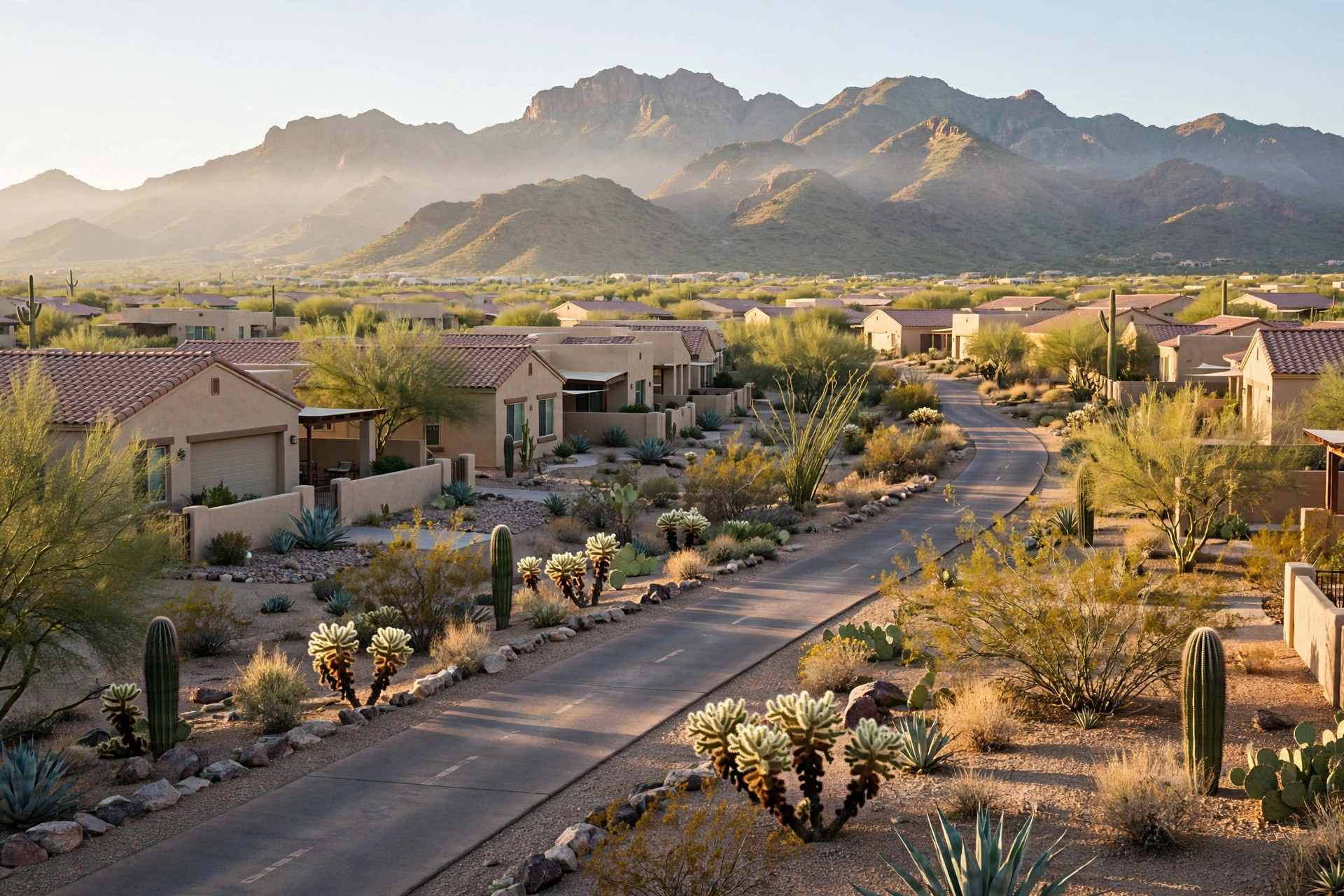
Green Valley is not a town either — there is no city hall and no mayor. It is an unincorporated Pima County community that was purpose-built for retirement starting in the 1960s, and it shows in the best way: most neighborhoods carry a 55+ deed restriction, the housing stock is overwhelmingly single-story, and about 86% of homes are owner-occupied (Census Bureau, ACS 2020–2024). The population swells in winter — this is the most snowbird-dense corner of the metro — and thins out through the summer heat, which is part of the rhythm you are buying into.
Geography matters here. Green Valley sits in the Santa Cruz Valley with the Santa Rita Mountains filling the eastern window — Madera Canyon, one of the most famous birding spots in North America, is effectively the backyard. Sahuarita, the family master-plan town, is the northern neighbor; Nogales and the Mexican border are under an hour south on I-19. Tucson's airport and south-side employers are an easy run north, and downtown Tucson is about 30 minutes in normal traffic.
Green Valley Recreation is the headline
Most Green Valley homes sit inside GVR's deed-restricted area, which makes the homeowner a member of Green Valley Recreation — the nonprofit that runs the community's recreation centers, pools, spas, fitness centers, sports courts, workshops, studios and hundreds of clubs and courses. Instead of one HOA amenity center, you get a whole town's worth of facilities on one membership. For active retirees, that infrastructure is the lifestyle: pickleball in the morning, a class or club at midday, a pool in the afternoon, and a social calendar that fills itself.
Two honest cautions. First, GVR membership comes with an initial fee when you buy and annual dues on top of any HOA dues your individual subdivision charges — price the total monthly cost, not just the purchase price; our 55+ communities guide shows how Green Valley's costs compare with SaddleBrooke, Sun City Oro Valley and Quail Creek. Second, the 55+ deed restrictions that keep the community's character also narrow your resale buyer pool later — a fair trade for most buyers here, but one to make on purpose.
What homes cost and what you get
The Census Bureau puts Green Valley's median owner-occupied home value at $293,500, and resale medians in the community commonly run in the low-to-mid $300,000s — against a metro median of about $370,000 and $555,000–$580,000 in Oro Valley. That gap buys real housing: the typical Green Valley home is a single-story detached house or townhome with desert landscaping, a covered patio oriented to the Santa Ritas, and low-maintenance yards designed for lock-and-leave winters. Median gross rent is about $1,171 a month (Census Bureau), which is why a meaningful share of snowbirds rent here first before buying.
Run the comparison the way our best neighborhoods for retirees guide does. Green Valley is the value pick with the deepest retiree infrastructure in the metro. Oro Valley costs roughly $200,000 more at the median and puts you 15–25 minutes from major hospitals and Tucson's northwest amenities. Quail Creek, on Green Valley's southern edge in Sahuarita, is the newer, resort-style version of the same idea at higher prices. If budget matters more than being inside Tucson itself, Green Valley is the answer I give first.
Daily life: quiet streets, real trade-offs
Day-to-day Green Valley is easy: grocery stores, medical and dental clinics, banks, restaurants and a weekly farmers market are all inside the community, and the streets are calm by design. Golf is everywhere — several courses thread through the neighborhoods — and the Santa Ritas handle the hiking and birding side; see our Tucson hiking guide for the Madera Canyon trailheads. Tucson itself is the weekly trip, not the daily one: the airport, the University of Arizona, Banner Health and Tucson Medical Center, and the big retail runs are all up I-19.
Be honest about the three recurring trade-offs. Health care: Green Valley has outpatient and clinic care locally, but a hospital stay means Tucson — plan for it, especially as you age in place. Summer: June through September is hot and the community quiets as snowbirds and many full-timers leave; if you will leave too, read the home-watch guide before you buy, and compare the full-year picture in our snowbird guide. Car dependence: there is no meaningful transit option — you will drive for anything beyond the local errand loop. None of these are hidden flaws. They are the terms that make the price possible.
Who Green Valley fits, and who it does not
Green Valley fits retirees and snowbirds who want an active, social, single-story life at the lowest full-amenity price in the Tucson metro, and who are comfortable treating Tucson as a 30-minute resource rather than a hometown. It does not fit working households who need Tucson's job market daily, anyone who wants young-family energy and top-rated K-12 schools at the door, or buyers who want to walk to nightlife. Those buyers belong in Sahuarita, Vail or in town — compare them in our South territory guide.
At a glance: Location: unincorporated Pima County, Santa Cruz Valley, ~25 miles south of downtown Tucson on I-19. Typical prices: median owner-occupied value $293,500 (Census Bureau, ACS 2020–2024); resale medians commonly low-to-mid $300,000s. Character: largely 55+, ~86% owner-occupied, snowbird-heavy winters. Best for: retirees and snowbirds who want GVR's recreation network at the metro's best value. Watch for: GVR initial fee + annual dues on top of HOA dues, the drive north for hospital care, summer heat and quiet, and 55+ resale limits.